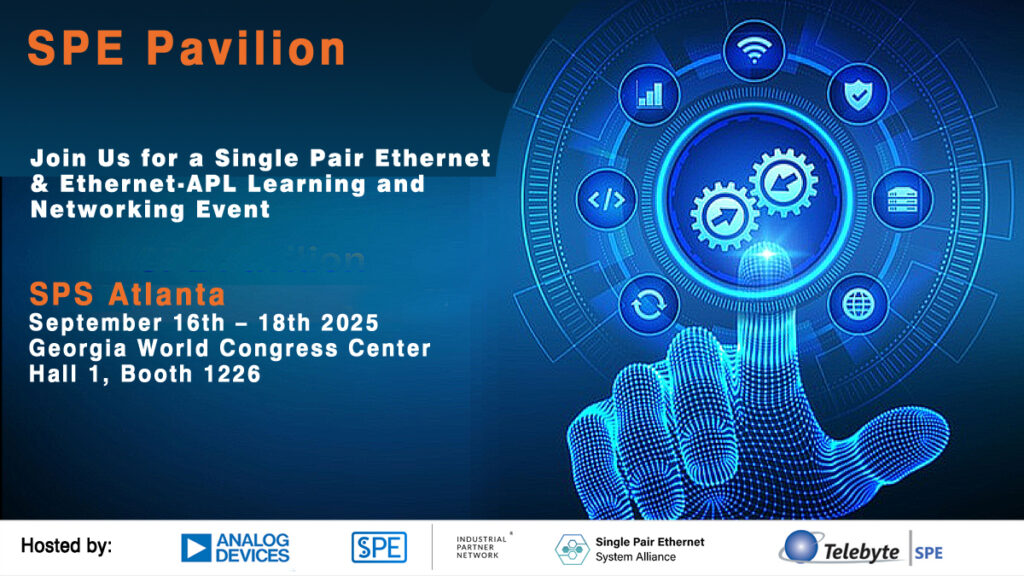
SPS smart production solutions is going global! After decades as a leading international automation tradeshow in Germany and Italy, SPS is making its US debut. Join us at SPS Atlanta on September 16 – 18, 2025 at the Georgia World Congress Center and experience cutting-edge technologies, global expertise, and hands-on learning. A key highlight will be our SPE Pavilion featuring a Single Pair Ethernet Exhibition & Education Conference, hosted by innovators Analog Devices, Single Pair Ethernet Industrial Partner Network, Single Pair Ethernet System Alliance, and Telebyte|SPE. We are looking forward to welcoming you at our SPE Pavilion.
The SPE Pavilion – A Unique SPE And Ethernet-APL Learning And Networking Event
Discover the world of Single Pair Ethernet including 10BASE-T1L, 10BASE-T1S, and Ethernet-APL live at SPS Atlanta! Get hands-on with demonstrations featuring SPE and APL solutions from multiple leading vendors and explore a wide range of components such as physics, magnetics, microcontroller units, cables, connectors, switches, and more.
Future-ready: Sharing SPE insights for your business
Attend our SPE lectures by industry experts in the theater area of the SPE Pavilion. As a visitor in the exhibit hall, you can attend the lectures for free.

Agenda & Presenters
Tuesday, September 16, 2025
| Time | Topics | Presenters | Company |
|---|---|---|---|
| 10:15am to 10:45am | 10BASE-T1S – Bringing Ethernet to the Edge for Industrial and Building Automation | Zeph Freeman | Microchip Technology |
| 11:00am to 11:30am | Keeping your network reliable over miles of copper with Cable Diagnostics | Peter Canty | Ananlog Devices |
| 11:45am to 12:15pm | Rewiring the Future: EtherNet/IP In-Cabinet Solutions with SPE T1S” highlights the transformative nature of SPE T1S in simplifying industrial wiring | Kelly Passineau | Rockwell Automation, Inc. |
| 12:30am to 1:00pm | CAPIEL European cooperation – In-cabinet devices interoperability | Panel Discussion | Weidmuller, Eaton, Rockwell Automation, Schneider Electric |
| 1:15pm to 1:45pm | The History of Ethernet-APL -the reference roadmap for Single Pair Ethernet development in industrial automation. | Arnold Offner | Phoenix Contact |
| 2:00pm to 2:30pm | Why Ethernet-APL? Unlocking the Full Potential of Industrial Ethernet | Sean Vincent | FieldComm Group |
| 2:45pm to 3:15pm | Relevance and adoption of Ethernet technologies in the process industries | Michael Bückel | Endress+Hauser |
| 3:30pm to 4:00pm | System Level Design Approach to meeting Intrinsic Safety in SPE/APL | Pran Haran | Smart Embedded Systems |
| 4:15pm to 4:45pm | Industrial Interoperability with OPC UA including SPE/APL, TSN and 5G | Paul Hunkar | OPC Foundation |
Wednesday, September 17, 2025
| Time | Topics | Presenters | Company |
|---|---|---|---|
| 10:15am to 10:45am | 10 Years of Single Pair Ethernet – A Review, Assessment and Outlook | Matthias Fritsche | HARTING |
| 11:00am to 11:30am | Why Single Pair Ethernet is ushering in a new era | Simon Seereiner | Single Pair Ethernet System Alliance |
| 11:45am to 12:15pm | SPE is more than just a new cable—it’s a new architecture | Dr. Al Beydoun | ODVA |
| 12:30am to 1:00pm | Designing an SPE Product | Mark Geisler | Analog Devices |
| 1:15pm to 1:45pm | Will your existing twisted pair cables support your T1S, T1L or Ethernet-APL deployment? | David Bessonen | Telebyte |
| 2:00pm to 2:30pm | SPE Product Realization, Developing SPE Products for the Next Generation of Factory Automation | Luis Torres | Methode Electronics, Inc. | dataMate |
| 2:45pm to 3:15pm | Single Pair Power over Ethernet – Intelligent Networking | Christopher DiMinico | SenTekse LLC |
| 3:30pm to 4:00pm | The Unified SPE Connector – Status and Impact for Users | Thomas Keller | Rosenberger |
| 4:15pm to 4:45pm | Unified Connectivity – SPE Switches for Industrial Network Integration | Ken Crawford | Weidmuller of North America |
Thursday, September 18, 2025
| Time | Topics | Presenters | Company |
|---|---|---|---|
| 10:10am to 10:40am | Single Pair Ethernet: Telecom Roots, Industrial Future | Philipp Rietzsch | Teleconnect GmbH |
| 10:50am to 11:20am | The global SPE standards landscape | Matthias Fritsche | SPE Industrial Partner Network |
| 11:30am to 12:00pm | Migrating from RS485 to networked operation Step by Step | Dr. Karsten Walther | Perinet GmbH |
| 12:10am to 12:40pm | Practical implementation of SPE solution for different uses cases | Abdul Wahab | Belden |
| 12:50pm to 1:20pm | SPE and Cybersecurity | Yuri Luskind | Zemfyre Inc. |
Presenter & Presentation Details

Presentation Title:
SPE is more than just a new cable—it’s a new architecture
Presenter: Dr. Al Beydoun
Company: ODVA
More Info
Bio: Dr. Al Beydoun serves as the President and Executive Director of ODVA. With a wealth of experience in engineering management and electronic systems, Dr. Beydoun began his career at Ford Motor Company and Visteon Corporation, working in the design and development of powertrain controls products, before moving to Lear Corporation. At Lear, he served as Director of Software and Systems Engineering, supporting global markets with various electronic modules.
Dr. Beydoun holds a bachelor’s and a master’s degree in electrical engineering from the University of Michigan, a Ph.D. in Electrical and Systems Engineering from Wayne State University, and an MBA from the Broad College of Business at Michigan State University.
Abstract: Single Pair Ethernet (SPE) represents a transformative shift in network architecture, far beyond the introduction of a new cable. By transmitting data and power over a single twisted pair—known as Power over Data Line (PoDL)—SPE dramatically reduces the size and weight of cabling infrastructure. This streamlined design enables more compact, efficient installations, especially in space-constrained environments like industrial machinery, robotics, and automotive systems. With longer reach capabilities—up to 1,000 meters in some cases—and support for high-speed data transmission, SPE extends Ethernet’s reliability and performance into places traditional Ethernet could never go, bridging the gap between legacy fieldbus systems and modern IP-based networks.
More than a physical upgrade, SPE redefines how systems connect and communicate from the edge to the cloud. Its simplicity and scalability make it ideal for Industry 4.0 and the Industrial Internet of Things (IIoT), where seamless integration of sensors, actuators, and controllers is critical. By enabling direct IP connectivity at the device level, SPE eliminates the need for complex protocol conversions and gateways, reducing latency and simplifying network design. This architectural shift empowers industries to build smarter, more responsive systems with real-time data flow, laying the foundation for predictive maintenance, autonomous operations, and advanced analytics. SPE isn’t just a cable—it’s the backbone of the next-generation industrial ecosystem.

Presentation Title:
Single Pair Power over Ethernet—Intelligent Networking
Presenter: Christopher DiMinico
Company: SenTekse LLC
More Info
Bio: Christopher DiMinico is co-founder of SenTekse LLC and President/CTO of PHY-SI LLC, producing Single Pair Ethernet equipment and high-speed test fixtures respectively. Chris has more than 40 years of experience in the telecommunication industry and is an active participant and technical contributor in IEEE 802.3 and TIA/TR-42 standards bodies. Chris is the chair of the 802.3.24.2 IoT Vertical Applications Task Group.
Abstract: 10BASE-T1L Single Pair Ethernet (SPE) combined with Single Pair Power over Ethernet (SPoE) specified in IEEE 802.3bu is the most cost-effective option for networking and powering 10 MB/s Ethernet devices to 1000 m and beyond. SPE will extend the plug and play simplicity of Ethernet to 10 MB/s Ethernet devices located in large open areas such as greenhouses, warehouses, parking garages, shopping malls, airports or to outdoor spaces for surveillance cameras and other smart remote devices (e.g., up to and beyond 1000 m. The single pair Ethernet standards are poised to provide a unifying communication protocol, a common networking infrastructure, and power for evolving sensor technologies and other edge devices (e.g., LEDs, actuator’s).
The presentation will compare and contrast current extended reach copper and hybrid copper-fiber options (>100 m) for a variety of applications addressing SPE infrastructure; cabling topology, power delivery, installation considerations, and testing. In addition. the presentation will provide nomenclature for assessing the intelligence of the Network infrastructure.

Presentation Title:
Migrating from RS485 to Networked Operation Step by Step
Presenter: Dr. Karsten Walther
Company: Perinet GmbH
More Info
Bio: Dr.-Ing. Karsten Walther is General Manager and the visionary head of the Perinet GmbH. He is expert in microelectronics, operating systems and IT communication with 27 years of experience in industry and academia. His philosophy is to create easy to use products by using modern technology, while bringing IT to new frontiers – namely extending the internet to tiny devices and thus gives IT better access to the periphery.
Abstract: How to modernize existing installations in industry or building automation to be IT driven and therefore less costly to maintain? Typically, this cannot be done in one step, since risk of downtimes are too high, it is not economically or there is no replacement option for all parts available. For installation which use RS485, Single Pair Ethernet allows to update an installation step by step. Thus, old equipment can be used as long as needed, while the required modernization e.g. better IT-integration or secure communication can be achieved with low efforts. In this talk we present how an RS485 installation can be modernized step by step with Single Pair Ethernet.

Presentation Title:
Industrial Interoperability with OPC UA including SPE/APL, TSN and 5G
Presenter: Paul Hunkar
Company: OPC Foundation
More Info
Bio: Paul Hunkar, Director of Compliance for OPC Foundation, is a seasoned expert in industrial automation interoperability, leveraging decades of experience with leading vendors and the OPC Foundation to elevate the quality and consistency of OPC implementations worldwide. As Director of Compliance and Certification, Compliance Working Group chair, and editor/editorial lead across OPC UA domains, he continues to shape the evolution of OPC standards, testing protocols, and interoperability workshops.
Abstract: OPC UA (Open Platform Communications Unified Architecture) is a key enabler for industrial interoperability from field to cloud. This presentation highlights how OPC UA supports seamless and secure communication across diverse transport protocols and physical layers such as Single Pair Ethernet (SPE)/Advanced Physical Layer (APL), Time-Sensitive Networking (TSN), and 5G. It introduces OPC UA FX (Field eXchange) for real-time field-level integration and OPC UA CX (Cloud eXchange) for scalable cloud connectivity.
The session also covers OPC UA’s powerful information modeling for semantic interoperability, built-in security features as well as its dual communication paradigms: Client/Server and Publish-Subscribe (PubSub). Attendees will learn how OPC UA enables flexible, standardized, and future-ready connectivity across heterogeneous industrial systems. And they will learn about OPC Foundation’s certification program which ensures compliance, interoperability, and quality across implementations, reinforcing trust in OPC UA-based solutions.

Presentation Title:
Keeping your network reliable over miles of copper with Cable Diagnostics
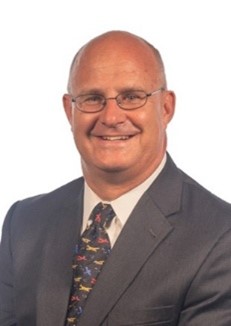
Presenter: Peter Canty
Company: Ananlog Devices
More Info
Presentation Title:
The History of Ethernet-APL: the Reference Roadmap for Single Pair Ethernet Development in Industrial Automation
Presenter: Arnold Offner
Company: Phoenix Contact
More Info
Bio: Arnold Offner has 30+ years in the field of industrial automation at Phoenix Contact. He has been involved the APL Project since 2018 and collaborated on numerous technical articles on the subject.
Offner studied Electronic Engineering Technology in South Africa, and Business Administration from Elizabethtown College (graduating during the COVID-19 lockdown). He is the author of various articles in factory and process automation, including instrumentation, interface technology and industrial automation.
Abstract: Ethernet-APL is the two-wire, loop-powered Ethernet Advanced Physical Layer that uses IEEE 10BASE-T1L plus 2-WISE design enhancements for installation in the hazardous areas of process plants. Ethernet-APL adopts technologies already established in the field of process automation.
Ethernet-APL was developed by a consortium of 4 SDO’s and 12 industry leading OEMS. It allows users to use either ethernet ring topologies, or the fieldbus trunk-and-spur topology.
Our presentation will cover the technical, conformance and marketing activities of the APL Project from 2018 to 2022 as a template for the various industry deployments of SPE.

Presentation Title:
10BASE-T1S – Bringing Ethernet to the Edge for Industrial and Building Automation
Presenter: Zeph Freeman
Company: Microchip Technology
More Info
Bio: Senior Manager- Business Development and Marketing. Senior executive with over 25 years of experience in high-speed semiconductor communications. I have extensive experience in automotive (ADAS and Autonomous Vehicles), industrial, commercial, and military industries for semiconductor development and design.
Abstract: Demonstrate advantages of using 10BASE-T1S for edge nodes. This lecture explores the transformative potential of 10BASE-T1S, a physical layer standard designed to extend Ethernet connectivity to the very edge of industrial and building automation networks. With its ability to operate over a single twisted pair and support multidrop topologies, 10BASE-T1S reduces complexity, enhances scalability, and lowers costs associated with traditional Ethernet deployments. Attendees will gain a detailed understanding of how this technology enables seamless integration of sensors, actuators, and control devices across distributed environments, while meeting the performance and reliability demands of real-time applications.
The session also examines practical design and deployment considerations—highlighting synchronization, collision avoidance via PLCA (Physical Layer Collision Avoidance), and compatibility with existing infrastructure. Through case examples and reference topologies, participants will discover how 10BASE-T1S simplifies network architecture, facilitates convergence between operational technology (OT) and IT systems, and supports a flexible migration path toward fully connected smart buildings and factories. Whether upgrading legacy systems or launching greenfield deployments, this lecture equips engineers and system integrators with the insights needed to harness Ethernet at the edge with confidence

Presentation Title:
Designing an SPE Product
Presenter: Mark Geisler
Company: Analog Devices
More Info
Bio: Presenter Bio: Mark Geisler is a Marketing Manager for Analog Devices Industrial Ethernet product line. He has held several roles across the engineering industry including System Architect for a medical device manufacturer, various field roles for Maxim Integrated and Analog Devices as well as his current role as Marketing Manager.
Abstract: This lecture explores the intricacies of designing a Single Pair Ethernet (SPE) product, highlighting key architectural and integration decisions that shape successful deployment. Beginning with an overview of SPE’s unique value proposition in industrial and IIoT environments, the session delves into essential design considerations—including system topology planning, retrofit versus greenfield strategies, and navigating protocol ecosystems. It presents a general block diagram to illustrate typical hardware architecture, while spotlighting the role of daisy-chaining via 10BASE-T1L to simplify layout and extend scalability.
The discussion advances toward practical engineering choices, including powering methods for SPE devices, microcontroller selection based on system demands, and implementing diagnostics to enhance reliability and maintainability. Attendees will gain insight into iterative development strategies, from early prototyping to full productization, with emphasis on performance validation and compliance. This lecture equips engineers and product developers with a grounded, strategic framework for building robust, future-proof SPE solutions tailored to evolving industrial needs.

Presentation Title:
Why Single Pair Ethernet is Ushering in a New Era
Presenter: Simon Seereiner
Company: Single Pair Ethernet System Alliance (SPESA)
More Info
Bio: Simon Seereiner has been heading the product management for “Passive Industrial Networking” at Weidmüller since 2005. Here he is responsible for the worldwide development and expansion of the industrial infrastructure portfolio. He has also been actively involved in shaping industrial networking in various national and international committees for many years. Since 2024 Simon takes the role as the Business development manager for Single Pair Ethernet. In addition to his work at Weidmüller and the standardization committees, he acts as the Director of the Board of the Single Pair Ethernet System Alliance.
Abstract: The development of the Ethernet standard as a global communication medium is a success story spanning more than 50 years. Ethernet is still on the rise, as recent studies show. Ethernet is also gaining in importance outside of factory automation. This is where Single Pair Ethernet (SPE) can act as a real “game changer.”
A major business trend is the development of the Industrial Internet of Things (IIoT) with digital twin models to increase the efficiency of manufacturing and distribution systems. The increasing connectivity and interoperability of switchgear and control units plays an important role in this. Challenges such as reducing the carbon footprint and new skills must be overcome.
Thanks to more powerful embedded electronics, switchgear and assemblies are becoming more and more intelligent. SPE allows these components to interact with the control systems. This presentation will analyze the potential transformation of industrial communication networks from traditional fieldbuses to SPE, as well as the associated challenges and benefits. Use cases and products for SPE infrastructure with a high level of practical relevance will be presented.

Presentation Title:
The Unified SPE Connector – Status and Impact for Users
Presenter: Thomas Keller
Company: Rosenberger Hochfrequenztechnik GmbH & Co. KG
More Info
Bio: Thomas Keller, M.Eng./Dipl.-Ing. (FH) studied Production Engineering at the University of Applied Sciences Rosenheim. He began his professional career in 2009 as a research associate at the university, contributing to various projects in tool development. In 2014, he joined Rosenberger Hochfrequenztechnik GmbH, initially as a Quality Engineer and later as a Product Manager for customized connector solutions in industrial applications. Since 2020, his professional focus has been on Single Pair Ethernet Connectivity. In this context, he also serves as a board member of the Single Pair Ethernet System Alliance, actively contributing to the advancement and standardization of this technology.
Abstract: In the course of SPS 2024, the PROFIBUS & PROFINET User Organization (PNO) presented a new connector system for PROFINET via SPE. The basis of this mating face is the data element from the SPE M12 Hybrid of the IEC 63171-7 standard. The uniform mating face is intended to bring clarity and security to end users in industrial communication and give the technology the long-awaited boost. To this end, cross-manufacturer standardization activities were launched and other user organizations from the industrial environment were involved.
SPE variants are also included in the new hybrid standardization IEC 61076-2-117. Until now, IEC standardization in the area of large, metric circular connectors has been missing, which is now covered by this standard and will drive the market penetration of single-cable solutions.
The presentation is intended to provide an overview of current standardization activities, a status of productization and a mood of acceptance for the new connector family. In addition, new markets for Single Pair Ethernet and the potential for other use cases are to be identified and evaluated.

Presentation Title:
The Global SPE Standards Landscape
Presenter: Matthias Fritsche
Company: SPE Industrial Partner Network e.V.
More Info
Bio: Matthias Fritsche studied electrical engineering at the Technical University of Ilmenau and has been working at HARTING in Espelkamp as a product manager for Ethernet data connectors and cabling systems since 2006. In his role as Senior Expert Ethernet Connectivity, he is a member of various Industrial Ethernet user groups such as PNO for PROFINET, ODVA for Ethernet/IP, ETG for EtherCAT, VNO for Varan as well as standards committees at IEC and TIA. Since 2015, he has been active in the IEEE 802.3 (Ethernet working group), where he is helping to drive forward standards for new transmission methods such as single pair Ethernet, remote powering, etc. Since 2024 he serves as Chairman for ISO/IEC JTC 1/SC 25 and Convenor for CENELEC TC 215 / WG 1.
Abstract: Overview about the SPE standards ecosystem including the SPE protocols from IEEE802.3, the components standards for cable and connectors and the cabling system standards with the guidance how to create the cabling for the different SPE use cases.

Presentation Title:
Unified Connectivity – SPE Switches for Industrial Network Integration
Presenter: Ken Crawford
Company: Weidmuller of North America
More Info
Bio: Technology change agent with many technology startup successes. Currently I am leading a sales enablement team with the challenging task of growing the automation business through IIoT offerings and services as well as complimenting and growing our automation portfolio.
Abstract: Single Pair Ethernet (SPE) is increasingly used in smart sensors and field devices to enable direct Ethernet or cloud connectivity. This requires appropriate network infrastructure, typically provided by SPE switches, which bridge single pair and traditional Ethernet ports.
The presentation explores the role of managed and unmanaged SPE switches in industrial settings. It covers SPE data transmission standards, Power over Dataline (PoDL) for device power supply, and key features and parameters to consider when designing SPE networks.
Unmanaged switches offer simple, configuration-free integration for SPE-enabled sensors and actuators, supporting various PoDL classes. Managed switches provide advanced configuration, diagnostics, and support for automation protocols, network security, and redundancy.
Real-world applications from mechanical engineering, renewable energy, and process technology demonstrate the flexibility and scalability of SPE-based industrial networks.
Presentation Title:
Will your Existing Twisted Pair Cable Support your 10BASE-T1L or Ethernet-APL Deployment?
Presenter: David Bessonen
Company: Telebyte, Inc.
More Info
Bio: David Bessonen is a member the Ethernet-APL / Ethernet SPE technical maintenance committee and is knowledgeable with hands-on, practical aspects of 10BASE-T1L physical-layer testing.
David graduated with a Bachelor of Science Degree in Electrical Engineering from Michigan Technological University in Houghton, Michigan, USA.
He brought his many years of experience and valuable technical expertise in xDSL, power and Ethernet testing applications with test instrumentation to Telebyte in 2012. During the past two years Mr. Bessonen has guided vendors and operators as they conducted lab testing SPE in North America, China and Europe.
Abstract: As industrial networks transition to Single Pair Ethernet (10BASE-T1L) and Ethernet-APL, a critical question emerges: can your existing twisted-pair infrastructure support this upgrade? This lecture introduces the technical foundation of T1L and APL technologies, emphasizing their potential to reduce installation complexity and leverage legacy wiring. It explores key standards—IEEE 802.3-2022, 802.3bu, and 802.3dd—while differentiating general-purpose T1L from the intrinsically safe and topology-specific APL framework. The session underscores the necessity of cable qualification to ensure reliable data transmission and safe operation in industrial and building automation environments.
Attendees will gain practical insight into essential electrical parameters like insertion loss, return loss, link delay, coupling attenuation, and mode conversion. The presentation highlights APL cable categories and Spur Power Classes, followed by a review of field testing methodologies including VNA and TDR techniques. Special attention is given to the Telebyte CQ10T1L cable qualifier – a standards-based tool designed for field validation, troubleshooting, and compliance documentation. By demonstrating how to assess cable readiness with go/no-go results, this session equips professionals with the diagnostic and planning strategies needed to confidently deploy T1L and APL systems on existing infrastructure.

Presentation Title:
Why Ethernet-APL? Unlocking the Full Potential of Industrial Ethernet
Presenter: Sean Vincent
Company: FieldComm Group
More Info
Bio: Sean Vincent is Director of Technical Services with responsibility for tool and technology program development. His experience includes HART, FOUNDATION Fieldbus and FDI technology related projects as a product developer, test engineer, field application engineer and technical trainer. Throughout his career Sean has designed, developed and supported embedded real-time systems as well as implementing various digital communications protocols and control systems. He administered successful product registration programs for the former Fieldbus Foundation and HART Communication Foundation. Sean is committed to improving the technologies, tools and service of the FieldComm Group.
Abstract: Industrial environments demand rugged, reliable, and scalable connectivity solutions, yet traditional Ethernet was never designed for these harsh conditions. With limitations like fragile RJ45 connectors, bulky multi-pair cabling, poor electromagnetic compatibility, and lack of intrinsic safety, early Ethernet technologies fell short of the reliability and safety needed for process automation.
Ethernet-APL (Advanced Physical Layer) is purpose-built to overcome these limitations. Designed specifically for the process industries, Ethernet-APL enables 10 Mbps transparent bidirectional communication and power delivery over a single shielded twisted pair supporting both power and data. With reach up to 1,000 meters and support for hazardous area installations via the 2-WISE (2-Wire Intrinsically Safe Ethernet) model, Ethernet-APL delivers the performance, safety, and flexibility required for modern industrial applications.
Attendees will learn how this technology overcomes the inherent limitations of legacy Ethernet while providing the long-awaited breakthrough for seamless, end-to-end digitalization. By combining real-time data access, simplified installation, and universal protocol support (e.g., PROFINET, HART-IP, Ethernet/IP, Modbus TCP, OPC UA), Ethernet-APL becomes the enabler of the modern, connected, and safe industrial plant.

Presentation Title:
Rewiring the Future: EtherNet/IP In-Cabinet Solutions with SPE T1S Highlights the Transformative Nature of SPE T1S in Simplifying Industrial Wiring
Presenter: Kelly Passineau
Company: Rockwell Automation, Inc.
More Info
Bio: Kelly Passineau is a Global Product Manager at Rockwell Automation with over 35 years of experience in industrial automation, specializing in EtherNet/IP and Single-Pair Ethernet (SPE) technologies.
He leads the development of EtherNet/IP In-Cabinet solutions powered by SPE, which revolutionize control panel design by enabling compact, cost-effective Ethernet connectivity for devices like motor starters, push buttons, and pilot lights. Kelly is at the forefront of driving SPE adoption in industrial environments, helping manufacturers transition to simpler, more scalable architectures.
A frequent guest on industry podcasts such as ROK Talk and The Automation Podcast, he is known for his practical insights into smart manufacturing and the future of industrial networking.
Abstract: For decades, industrial control panels have relied on point-to-point wiring to connect devices like motor starters, push buttons, and pilot lights. While effective, this approach introduces complexity, limits scalability, and restricts access to device-level data. With the emergence of Single Pair Ethernet (SPE) T1S, engineers now have a standards-based alternative that supports multidrop Ethernet communication over a single twisted pair, enabling a shared media approach inside the cabinet.
This session explores how SPE T1S, is being applied to create EtherNet/IP In-Cabinet architectures that reduce wiring and enable smarter diagnostics. Attendees will gain a deeper understanding of the T1S and how composite media can deliver both power and data to multiple devices. We’ll also explore how this solution aligns with ODVA’s specifications, anticipates integration with CIP Safety, and supports future scalability.
This session is designed for engineers, system integrators, and automation professionals. This presentation provides a practical, standards-driven look at how SPE T1S is reshaping control panel design and what it means for the future of industrial Ethernet.

Presentation Title:
Relevance and Adoption of Ethernet Technologies in the Process Industries
Presenter: Michael Bückel
Company: Endress+Hauser
More Info
Bio: Michael Bückel has been with Endress+Hauser since 2011. He has worked in different positions in R&D and marketing. Since 2019 he has been heading the marketing department for flowmeter transmitters.
In this role, he supervises a team of product managers with focus on system integration, enhanced diagnostics, IT/OT security, operational tools, and lifecycle management of the Endress+Hauser flowmeter transmitters.
Michael has expert knowledge of major PLC and DCS systems, especially in the working field of digital integration and connectivity of sensors within process automation in several industry sectors like Oil & Gas, Chemical, Food and Beverage, as well as Water/Wastewater.
Since the beginning of the Single Pair Ethernet technology (IEEE Std 802.3cg-2019 10 Mb/s), he has been working on the adoption of this connectivity in the transmitter portfolio of Endress+Hauser.
Abstract: In today’s increasingly connected industrial and automation environments, the demand for efficient, scalable, and cost-effective communication technologies continues to grow. This presentation introduces Single Pair Ethernet (SPE), a transformative evolution of well-known Ethernet that enables data transmission and power delivery over a single twisted pair of wires. SPE is poised to simplify network architectures, reduce cabling costs, and extend Ethernet connectivity to previously unreachable devices and environments.
We will explore the foundational concepts of Ethernet, explain what SPE and APL have in common and why it is a perfect match for connectivity in the field. A special focus will also be given to Advanced Physical Layer (APL), a subset of SPE tailored for process automation, offering intrinsic safety and long-distance communication capabilities.
Attendees will gain a clear understanding of:
The basics of Ethernet and its role in digital communication
What Single Pair Ethernet is and why it matters
The significance of APL in industrial applications
Real-world use cases and future potential of SPE across industries
Whether you’re an engineer, technician, IT professional, or simply curious about emerging connectivity standards, this session will provide a solid foundation to appreciate the impact and promise of SPE and APL in the evolving landscape of industrial networking.

Presentation Title:
Practical Implementation of SPE Solution for Different Use Cases
Presenter: Abdul Wahab
Company: Belden
More Info
Bio: B.Sc. and M.Sc. in Mechanical Engineering
Initial experience in R&D of ethernet switches
Currently working as a Product Manager for DIN Rail Switches for Belden
Also, leading SPE/APL portfolio of Belden
Abstract: As standardization around SPE is getting finalized, there is still a gap between customer understanding of SPE and what can be done practically. There are different connector types, cable AWG types, which provide different bandwidths up to certain distances. I want to share what combinations are practical for different use cases to educate the audience on what they need to consider to practically implement the SPE solution for their use case effectively and successfully.
Presentation Title:
10 Years of Single Pair Ethernet – A Review, Assessment and Outlook
Presenter: Matthias Fritsche
Company: HARTING
More Info
Bio: Matthias Fritsche studied electrical engineering at the Technical University of Ilmenau and has been working at HARTING in Espelkamp as a product manager for Ethernet data connectors and cabling systems since 2006. In his role as Senior Expert Ethernet Connectivity, he is a member of various Industrial Ethernet user groups such as PNO for PROFINET, ODVA for Ethernet/IP, ETG for EtherCAT, VNO for Varan as well as standards committees at IEC and TIA. Since 2015, he has been active in the IEEE 802.3 (Ethernet working group), where he is helping to drive forward standards for new transmission methods such as single pair Ethernet, remote powering, etc. Since 2024 he serves as Chairman for ISO/IEC JTC 1/SC 25 and Convenor for CENELEC TC 215 / WG 1.
Abstract: Back in 2014, IEEE 802.3 began work on the first SPE standard for 100BASE-T1 – 100 Mbps for Automotive Ethernet. Today, 10 years later, there is a multitude, perhaps even chaos, of different SPE protocols and PoDL remote feed classes. And further protocols are being developed.
High expectations are placed on Single Pair Ethernet technology for a wide range of applications, and the enthusiasm remains high. But where do we stand today, and what is needed for these expectations to be met in the market beyond the initial target applications in vehicles?
Starting with a brief update of the IEEE 802.3 standards landscape, the components and cabling standards, and the activities of user organizations, this presentation will introduce the SPE ecosystem with the components currently available.
What can be done with this SPE ecosystem? Why are there so few applications outside of vehicles to date? The simplicity of SPE technology, with just one wire pair, delivering virtually the same performance as 4-pair Ethernet systems, excites engineers. But is this enough to enthuse potential users and customers? What problems does SPE solve? What applications are enabled for the first time with SPE? What are the measurable economic benefits?
Using selected practical examples, this presentation will answer these questions and invite the audience to explore further application areas. This presentation aims to provide participants with a comprehensive overview of the current status and real-world applications of SPE.

Presentation Title:
Single Pair Ethernet: Telecom Roots, Industrial Future
Presenter: Philipp Rietzsch
Company: Teleconnect GmbH
More Info
Bio: Philipp Rietzsch (CTO, Teleconnect GmbH) studied communication technologies at the University of Applied Sciences in Dresden, Germany. He has been working at Teleconnect since 2005 in various positions, focusing on the development of xDSL systems, optical transmission technologies, PLC and SPE. He is a regular speaker at conferences and has authored various publications and several patents.
Abstract: This presentation explores the technological foundations and evolution of Single Pair Ethernet (SPE), highlighting its roots in DSL and telecom systems. It compares modulation techniques, power-feeding methods, and performance across SPE, DSL, and PLC technologies in the context of solution development. Key standards like 10BASE-T1S, 10BASE-T1L, and 100BASE-T1 are examined alongside legacy solutions and modern alternatives. The session concludes with a comprehensive comparison of capabilities, helping attendees position each technology within industrial and retrofit communication strategies.

Presentation Title:
SPE and Cybersecurity
Presenter: Yuri Luskind
Company: Zemfyre Inc.
More Info
Bio: Yuri Luskind is the President & CEO of Zemfyre, a Canadian leader in industrial networking and cybersecurity innovation. Prior to founding Zemfyre, Yuri served as CTO at iS5 Communications/Phoenix Contact and as Director of Engineering at Ruggedcom/Siemens, where he led the design and development of advanced communications platforms for mission-critical infrastructure. Throughout his career, Yuri has held senior and executive roles at leading technology companies in the U.S. and Canada, including Fore Systems and Marconi Communications. He holds an MBA from Queen’s University (Canada) and an MSc. in Electrical Engineering from MIIT in Moscow. Yuri is the holder of five U.S. patents and a contributing member of SPESA, IEEE, and CIGRÉ.
Abstract: Single Pair Ethernet (SPE) is more than just a physical layer connectivity standard—it’s also a game-changer for Industrial Control System (ICS) cybersecurity. This presentation will explore the critical role SPE plays in enhancing cybersecurity by enabling the integration of field-level devices into the Operational Technology (OT) Cybersecurity Framework and improving visibility, segmentation, and security management. Additionally, we will examine the approaches and solutions necessary to address the new functionalities that the SPE enables.

Presentation Title:
System Level Design Approach to meeting Intrinsic Safety in SPE
Presenter: Pran Haran
Company: Smart Embedded Systems
More Info
Bio: Pran Haran has more than 30 years of experience in leading engineering teams in successful development of products from conception to production. He has led embedded software and applications development for many successful companies such as Meru Networks, U4rea Networks, Force Computers and Smart Modular technologies. He brings great experience in managing multi-site product development and Agile methods. He did his MSEE, Kansas State University, Kansas, USA & BS in EE, IIT, Chennai, India
Abstract: SPE designs operating in Intrinsic Safe Zones 0 and 1 are required to meet certain maximum power constraints, in rush current and current derivatives. At the same time, they need to meet performance requirements for their intended instrumentation applications with fast updates. We will discuss how design can be managed to meet these competing objectives.
Presentation Title:
SPE Product Realization, Developing SPE Products for the Next Generation of Factory Automation
Presenter: Luis Torres
Company: Methode Electronics, Inc. | dataMate
More Info
Bio: Luis Torres is a seasoned technology executive with over four decades of leadership experience in data communications, broadband access, military and aerospace systems, and industrial connectivity. Currently serving as Business Unit Manager at Methode Electronics, Luis leads the dataMate division, where he’s been driving innovation and expanding into new market segments including industrial connectivity and networking with Single Pair Ethernet products.
Throughout his career, Luis has held senior roles in engineering, product development, and business leadership at companies including Stratos Lightwave, Amphenol and COTSWORKS. His work has ranged from architecting cutting-edge optical transceivers to launching entirely new product lines. He’s also been a key player in a successful IPO.
With a background in Electrical and Electronic Engineering from the University of Surrey (UK) and thirteen awarded patents, Luis is not only a hands-on innovator but also an advocate for technical excellence and cross-functional collaboration. He’s been a contributor to standards bodies such as IEEE, ANSI, SMPTE and industry associations including, Homegrid Forum and Single Pair Ethernet System Alliance and brings a global perspective and proven track record of success.
Abstract: This presentation offers a practical and comprehensive approach to Single Pair Ethernet (SPE) product realization – guiding attendees from initial requirements through to fully developed, deployment-ready solutions. I will showcase existing product lines—including managed and unmanaged switches, media converters, and PoDL-powered field-level devices—alongside key components such as core building blocks, operating systems, and cybersecurity considerations, all within the framework of SPE development. Whether you’re beginning your evaluation or actively pursuing product development, this session highlights not only how to build SPE-based solutions effectively, but also emphasizes that robust, ready-to-use technologies are available today to accelerate your SPE journey.
Don’t miss this unique opportunity to experience SPE technology, products, and industry expertise — all in one place.
Exhibit Participants and Sponsors